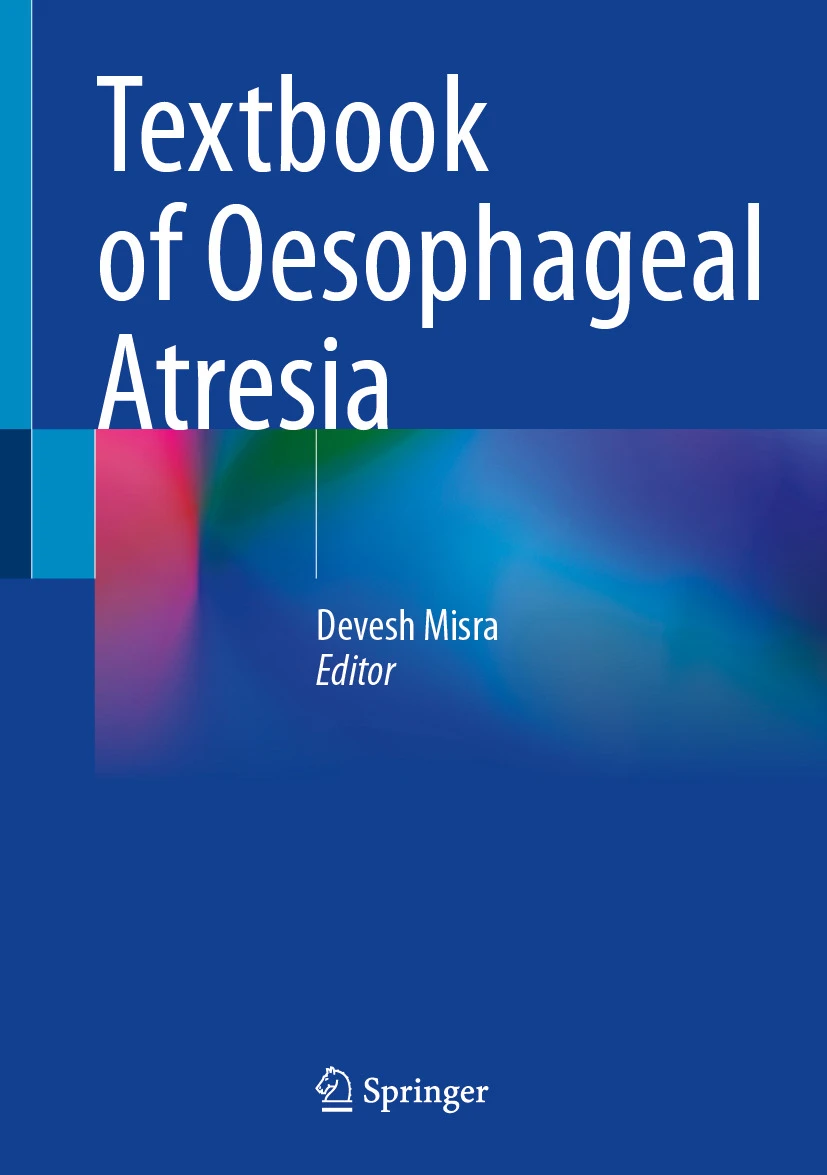
Book review – Textbook of oesophageal atresia
 by Augusto Zani
Professor of Surgery, Washington University School of Medicine
Saint Louis Children’s Hospital, Saint Louis, USA
The publication of Textbook of Oesophageal Atresia marks an important milestone for the paediatric surgical community. The management of oesophageal atresia and tracheo-oesophageal fistula (OA/TOF) lies at the heart of paediatric surgery, and centres worldwide regard their outcomes in this condition as a benchmark of excellence.
The first aspect that strikes the reader is the truly global reach of this academic endeavour. Although the editor, Devesh Misra from the Royal London Hospital, UK, has led the project, the contributing authors represent many of the world’s leading centres and include some of the most respected names in the field. Their diverse perspectives provide readers with valuable insights into institutional protocols and clinical philosophies developed across Europe, North America, Asia and Australia. The editor has succeeded in creating a volume that is not merely a collection of chapters, but a coherent, authoritative and comprehensive reference text.
The book comprises 32 chapters covering the entire spectrum of oesophageal atresia. It begins with an engaging historical account by Georgina Bough and Shaun Kunisaki from Johns Hopkins University, Baltimore, tracing the remarkable evolution of OA/TOF from its earliest descriptions to the sophisticated surgical techniques of today. This historical perspective is followed by outstanding chapters on embryology and anatomy by Merrill McHoney from Oxford, prenatal diagnosis by Elena Greco (Royal London) and Francesco Iaculli from Bambino Gesù Children’s Hospital, Rome, genetics and associated syndromes by Ami Pedersen and Devesh Misra, neonatal management by V. Murthy and congenital cardiac anomalies by Filip Kucera and Oliver Bates from Great Ormond Street. Together, these chapters provide an excellent scientific and clinical foundation before the reader embarks on the surgical management of these complex patients.
Merrill McHoney’s chapter is notable for two reasons. First, it incorporates cross-sectional radiological anatomy, helping surgeons develop a more sophisticated understanding of mediastinal structures. Second, it correlates thoracoscopic findings with bronchoscopic and radiological images across the various OA/TOF subtypes, creating a uniquely practical learning resource.
The medical aspects of care are particularly well represented. The chapter on Oesophageal Physiology and Investigative Modalities, by Osvaldo Borrelli from Great Ormond Street is particularly impressive. Containing over 220 references, it provides an outstanding review of high-resolution impedance manometry (HRIM), endoluminal functional lumen imaging probe (EndoFLIP), and pH-multichannel intraluminal impedance (pH-MII), highlighting the increasingly sophisticated tools now available for evaluating oesophageal function.
Operative management is explored in exceptional depth. Repair by open thoracotomy receives detailed attention, with Devesh Misra describing his own technical refinements developed over more than three decades of experience, resulting in exceptionally low complication rates. As Steve Rothenberg from Rocky Mountain Hospital for Children, Denver, observes in his foreword, the logical next step should be the incorporation of these principles into thoracoscopic and robotic platforms.
As minimally invasive surgery continues to gain wider acceptance, it is fitting that four chapters are devoted to this approach. Dariusz Patkowski from Wroclaw Medical University, Poland, one of the pioneers of thoracoscopic repair of OA, authors the principal chapter and presents updated results extending to 2025. Complementary chapters by Ravi Kanojia from PGIMER, India, discuss anaesthesia for thoracoscopy, intraoperative complications, and the important but often under-discussed topic of conversion to open surgery. Nor Lan Lau and Anil Visram also provide an excellent overview of anaesthesia for open repair, reminding readers that optimal outcomes depend as much on advances in perioperative care as on surgical technique itself.
No textbook on oesophageal atresia would be complete without a comprehensive discussion of long-gap OA. This challenging condition is addressed in five outstanding chapters. Agostino Pierro from Hospital for Sick Children, Toronto, together with Lorenzo Añez Bustillos, provides an authoritative overview of delayed primary repair and gastric transposition, while Thomas Hamilton from the Children’s Hospital of Philadelphia discusses the Foker’s technique with its minimally invasive evolution, and Benjamin Zendejas from Boston Children’s hospital discusses the super-charged jejunal interposition technique. Colonic interposition has been modified by M. Eldebeiky and team from Cairo and is presented with vivid photographs. These chapters reflect both the remarkable ingenuity that has characterised this field and the continuing commitment to preserving the native oesophagus whenever possible.
The Melbourne group published the first textbook dedicated to oesophageal atresia more than 35 years ago. It is fitting that Warwick Teague and Ram Nataraja from the Royal Children’s Hospital, Melbourne, continue that tradition with an excellent chapter on H-type tracheo-oesophageal fistula. Equally impressive is the contribution from Great Ormond Street Hospital, where Ben Hartley, Paolo De Coppi, Stefano Giuliani, Dhanya Mullassery, and colleagues share their extensive experience in bronchoscopy, tracheomalacia, strictures, missed upper pouch fistula and recurrent tracheo-oesophageal fistula. Oliver Muensterer from Munich discusses the ubiquitous problem of anastomotic leaks. Additional chapters address important but less common challenges, including right-sided aortic arch and chylothorax, ensuring that readers are well equipped to manage the full spectrum of perioperative and postoperative complications.
The controversies surrounding gastro-oesophageal reflux are thoughtfully discussed by Osvaldo Borrelli from Great Ormond Street Hospital, while the surgical management of reflux is reviewed by Riadh Cheddadi and Augusto Zani from Washington University, St. Louis. Together, these chapters provide a balanced overview of one of the most debated aspects of long-term OA management.
Recognising that the vast majority of children with OA now survive well into adulthood, the textbook includes dedicated chapters on long-term respiratory morbidity and gastrointestinal follow-up. Caroline Pao and Rebecca Thursfield from Alder Hey Children’s hospital, Liverpool discuss respiratory outcomes, while Shawn St. Peter from Children’s Mercy Kansas City, Missouri, provides a particularly valuable review of endoscopic surveillance and the potential risk of oesophageal malignancy in adult survivors, emphasising the importance of lifelong multidisciplinary care.
One of the most enjoyable chapters is Radiological Case Studies, Atypical Cases and Lessons Learned Over 35 Years in Oesophageal Atresia, written by Devesh Misra together with radiologist Anoushka Ljutikov. The carefully selected cases challenge even experienced surgeons and illustrate the wealth of practical knowledge accumulated over an exceptional career devoted to this condition. Throughout the book, readers will encounter similar clinical pearls, technical insights and thoughtful observations from Misra that transform a reference textbook into a distillation of decades of experience.
The educational value of the textbook extends beyond its clinical content. Devesh Misra shares mentoring advice on how to publish long clinical series and lifetime work, followed by a self-assessment quiz by M Abdullah and Shilpa Sharma from AIIMS, New Delhi that will be particularly valuable for trainees preparing for examinations. The book concludes with an excellent overview of the landmark international TOAST trial by Iain Yardley from Evelina Children’s Hospital, and Nigel Hall from the University of Southampton, highlighting how collaborative multicentre research continues to shape the future of OA care.
Springer has produced this volume to a very high standard. The high-quality colour illustrations, operative photographs, radiological images, bronchoscopic images, and diagrams greatly enhance the educational value of the text.
Few textbooks succeed in bringing together the collective wisdom of so many pioneers in a single volume. Through Devesh Misra’s vision and the contributions of experts from many of the world’s leading centres, Textbook of Oesophageal Atresia achieves exactly that. Comprehensive, authoritative and beautifully illustrated, it is destined to become the definitive reference on oesophageal atresia and tracheo-oesophageal fistula, and an indispensable resource for paediatric surgeons, trainees, neonatologists, gastroenterologists, pulmonologists and all clinicians involved in the care of these complex patients.
Augusto Zani
Professor of Surgery, Washington University School of Medicine
Saint Louis Children’s Hospital, Saint Louis, USA