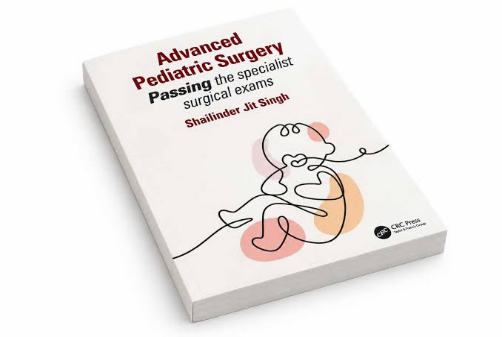
Advanced Pediatric Surgery: passing the specialist surgical exams
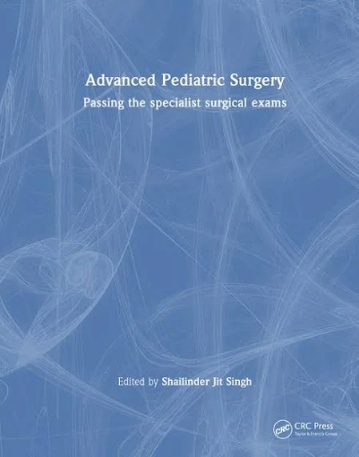 Editor – Shalinder Jit Singh
Published 2026
This is a mighty tome of 619 pages in 84 chapters from the collected insights of a whole host of international contributors rounded up by Shalinder Singh, long-time BAPS member in Nottingham. He seems to have had a gift of picking up promises to write during his peripatetic career from India, via the East Midlands to Washington DC and back again.
 The book’s contents start at the neck (5 chapters), descend into the thoracic (14 chapters), before winding up within the abdomen (50+ chapters). There are then chapters on tumours, trauma, and some miscellaneous subjects such as burns, antenatal diagnosis and the surgical problems of the severely preterm. This is a lot of material to digest, commit to memory and regurgitate in front of an examinations viva committee or indeed onto an MCQ answer sheet. Given its otherwise comprehensive nature I was a little surprised at the omission of hard-core urology – urethral valves, bladder exstrophy etc., and I guess this is a lean towards the American model where these are genuinely separate. By contrast the UK’s curriculum counts urology as up to 20% of content.
The structure of each chapter is stereotypically broken into Introduction; Anatomy; Assessment; Investigations; etc, which is fair enough but does lead to duplication and repetition in subject-adjacent chapters. However, there is considerable interpretation of what this means by different authors. Some quote reference lists, others none at all. Use of tables is variable, the surgical pancreas chapter has 21, for instance, which seems excessive. Sometimes the details in the text are overwhelming and I would suggest unnecessary – did you know there are 10 named cervical lymph node groups, six of which have sub-groups – 17 in all!
Doing a deep dive into content I looked at Andrew Hollands (Sydney, Australia) on Undescended Testis, which is really good – fluent writing, relevant clinical algorithms and all contentious points suitable referenced – though he ignores what seems to the up and coming Shehata technique for the intrabdominal testis somewhat. Naveed Alizai’s (Leeds, UK) formidably detailed chapter, on Choledochal Malformation by contrast contained no references but the step-by-step approach as to how he actually performs the surgery itself which was fascinating but was way beyond the needs of any surgical trainee.
So, what was the aim of the book? Who is the target audience? The title certainly seems to suggest that it is to address the exam needs of the surgical trainee, although the format, content and detail appears way too comprehensive for this. This is not a last-minute crammer to peruse on the train on the day before the exam, for sure. Nevertheless, given this as an explicit aim, I would have appreciated some overview of the post-graduate exams candidates are likely to encounter across the world. The ones I’m most familiar with are the European UEMS and the UK’s FRCS (Paediatric Surgery) but of course there are a whole host of Board exams in the USA and Canada. There is a lot of variation in illustrations – these are all in B&W but range from the professional AI schematics to the ones seemingly done by the author’s children!
 For a small sub-specialty, there is a lot of competition out there. Modesty prevents me mentioning our own contributions in any detail – but these were much more focused on essentials for exam-orientated trainees in a smaller Handbook format from Oxford University Press. The recent books by Paul Losty and Martin Corbally – Essential Surgery – a Practical Guide is only 3 years old, and the even more up-to-date Oxford Textbook of Paediatric Surgery by Paul Johnson et al. was published only this year. Both are comparable in size and scope although the latter rather more anglo-centric in its list of authors.
So, in conclusion you can buy this book in paperback from the Routledge website (1), for an astounding £70 which is, considering the detail within, extraordinarily good value and it would make someone a very nice Christmas present. By contrast hardback versions seem to on sale at about £200 or so – more like I would expect for its content and size.
Curated by Prof. Mark Davenport
King’s College Hospital, London